
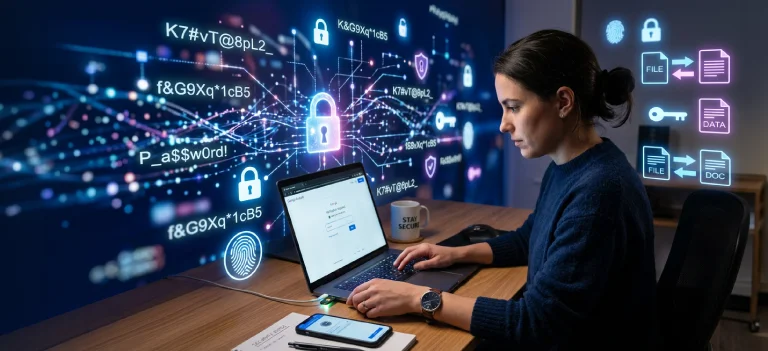
For years, every company that suffered a cyber breach had a very familiar narrative to share: sophisticated hackers outsmarted their system. The villains were always shadowy figures in hoodies, typing quickly in basements from distant corners of the world. Victims, of course, were helpless organizations caught off guard.
That story is outdated and has been for some time.
The uncomfortable truth is this: cybersecurity is no longer just the IT department’s responsibility. It belongs to all of us.
In today’s connected world, breaches are rarely the result of a single brilliant exploit. More often, they succeed because of ordinary behavior—routine clicks, reused passwords, overlooked updates, and unexamined digital footprints. The uncomfortable truth is this: cybersecurity is no longer just the IT department’s responsibility. It belongs to all of us.
If you use a laptop, carry a smartphone, use a tablet, connect to Wi-Fi, or log into web applications—at work or at home—you are part of the security perimeter. And that means accountability.
The Ever-Expanding Digital Footprint
Every professional now maintains a significant digital footprint. We use:
- Corporate laptops for email, documents, and video meetings
- Personal smartphones for messaging, banking, and work applications
- Cloud platforms for file storage and collaboration
- Personal devices connected to home Wi-Fi networks
- Public Wi-Fi at airports, hotels, and coffee shops
Each device and application increases convenience and productivity. But each also creates a potential pathway—what both the good-guy and the bad-guy security professionals call an “attack vector.” An attack vector is simply a route that attackers use to gain access. The challenge is that as technology advances and as we take advantage of these advancements, the modern work environment have thousands of attack vectors, with more showing up almost daily.
For example, your LinkedIn profile reveals your job role. Email address appears in multiple data breaches. Reused password from a shopping site unlocks your corporate VPN. Your unpatched home router provides a foothold into a company laptop you use remotely. Individually, these actions seem harmless, but collectively, they form a detailed map. Attackers don’t need to break down the front door when employees are unknowingly leaving windows open with every interaction.
The Target Lesson: It’s Never “Just” a Vendor
Consider the well-known breach at Target in 2013. Attackers didn’t storm the retailer’s main systems directly. Instead, they entered through a third-party HVAC contractor that had remote access for billing and maintenance purposes. A so-called low-priority system became the attackers’ key to the back door of the entire enterprise network. From there, they moved laterally through the network and ultimately compromised millions of customer payment cards.
The breach wasn’t caused by a genius-level technical breakthrough. It was the result of interconnected systems and trusted access that wasn’t sufficiently segmented or monitored. In other words, it was an ecosystem problem. And today, every company and its employees operates within an ecosystem—vendors, partners, contractors, connected devices, cloud providers, etc. When we grant access, when users reuse passwords, or ignore basic hygiene, we extend trust. If that trust is misplaced or poorly managed, the entire organization can pay the price.
STUXNET: Counting on Human Nature
Another powerful example is Stuxnet, one of the most sophisticated cyber weapons ever discovered. It targeted Iranian nuclear centrifuges, many of which were isolated from the public internet. So how did the malware reach these isolated, protected systems?
Through people, acting like cybersecurity was someone else’s concern.
STUXNET spread via infected USB drives, relying on normal human behavior—plugging in removable media found in the environment. It didn’t need a direct network connection to succeed. It saturated the local ecosystem and depended on curiosity and routine habits to bridge the final gap. The lesson is sobering: even air-gapped systems can be compromised if human behavior isn’t aligned with practical and continuous security awareness. Technology alone cannot compensate for predictable human patterns.
The Modern Professional: Always Connected, Always Exposed
Today’s workforce is mobile and hybrid. We work from corporate offices, home offices, hotel rooms, and shared spaces. We access:
- SaaS applications via browsers
- File-sharing platforms
- Messaging apps
- CRM systems
- Cloud storage accounts
- And far too often, Social Media and other personal services from work devices
Each login generates credentials. Each credential is a potential liability. Frustratingly, many professionals still reuse passwords across multiple platforms. When one site is breached, attackers test those same credentials against corporate accounts—a tactic known as credential stuffing. Similarly, unpatched devices—whether laptops, mobile devices, or home routers—become easy targets. Software updates can feel inconvenient, but they often patch known vulnerabilities that attackers actively scan for.
Even something as simple as clicking a link in a convincing email can initiate a breach. Phishing attacks are increasingly personalized, drawing from publicly available data on social media and company websites. Attackers are not relying solely on technical exploits, and that room full of hackers in hoodies in the basement. They are leveraging information we users willingly publish and behaviors we repeat daily.
The Myth of the “IT Problem”
Many professionals assume cybersecurity is “handled” by IT or the security team. That the IT department has made the system secure enough for everyday users to go about their usual tasks without needing to think about or consider the impacts they are making. Firewalls, endpoint detection, and monitoring tools certainly play a critical role. But they have limits, and they cannot control:
- What you post online
- Whether you reuse passwords
- Whether you enable multi-factor authentication
- Whether you connect any device to unsecured Wi-Fi
- Whether you verify a suspicious email
Hackers are opportunistic, they exploit what is available, and users are creating wider and broader footprints of opportunities every day.
Security technology is reactive and defensive. Human behavior is proactive and preventative. The perimeter is no longer a building. It is each individual device and each individual user. When an employee connects a compromised personal device to a corporate system, that device becomes part of the enterprise attack surface. When someone forwards sensitive documents to a personal email account “for convenience,” they create a new exposure channel. Blaming hackers alone ignores this reality. Hackers are opportunistic, they exploit what is available, and users are creating wider and broader footprints of opportunities every day.
Convenience vs. Risk: The Daily Tradeoff
As users, we are always trying to get more done in less time, and we value speed and ease with things like: Auto-saved passwords; One-click approvals; Shared credentials; Quick file transfers; and even public Wi-Fi for productivity on the go. But speed and convenience often erodes friction—and friction is sometimes what keeps us safe. For example:
- Multi-factor authentication adds seconds to login but blocks most unauthorized access attempts.
- Software updates interrupt workflow but eliminate known vulnerabilities.
- Segregating work and personal devices adds cost but reduces cross-contamination risk.
Security is not about eliminating functionality. It is about making informed tradeoffs. The challenge, and risk, arises when users do not recognize that they are making tradeoffs at all, because they think cybersecurity is someone else’s job to manage.
Accountability in the Age of Digital Citizenship
In the physical world, we feel pretty confident that we know what to do to remain safe, and compliant. We lock our doors, shred sensitive documents, and secure valuables. We understand that negligence can invite theft. The digital world demands similar habits, even when they seem tricker to make into habits, such as:
- Use unique, complex passwords (preferably managed by an enterprise-grade password manager).
- Enable multi-factor authentication everywhere possible.
- Keep devices updated—laptops, phones, routers, tablets, home devices, etc.
- Avoid plugging in unknown USB devices.
- Verify unexpected emails, especially those requesting credentials or urgent action.
- Separate personal and professional accounts whenever feasible.
These actions are not advanced cybersecurity techniques. They are modern professional hygiene, that do require extra steps and self-accountability. Accountability does not mean assuming blame for every breach – it means acknowledging that every user influences the organization’s risk posture, and that each user can take straightforward steps to help minimize that risk.
A Cultural Shift Is Required
The companies that will succeed in today’s threat landscape are those that cultivate security-aware cultures—not fear-driven compliance, but informed engagement and training that instill news habits and practices.
Leaders must communicate that:
- Cybersecurity is a shared responsibility.
- Reporting suspicious activity is encouraged, not punished.
- Training is not a checkbox but a necessity.
- Security decisions are business decisions.
Employees must internalize that their personal digital behavior—at home and at work—can impact their employer, their customer base, and potentially their own personal life and finances. The boundary between personal and professional technology is thinner than ever. A compromised personal email account can lead to spear-phishing, an infected home network can affect a remote corporate laptop, and so on. The largest and most effective attack surface is human.
Stop Blaming, Start Owning
Hackers will continue to innovate. That is a given. They are creative and are always poking and prodding and finding new ways to use something in an unexpected manner. But breaches are no longer solely about technical brilliance on the attacker’s side. They are about complexity, connectivity, and everyday behavior. The breach at Target was enabled by trusted third-party access. STUXNET succeeded by exploiting predictable human habits. Modern ransomware campaigns succeed because someone clicks, reuses, or ignores and just goes about their day, unaware of the floodgates they just accidentally opened.
Cybersecurity today is less about defending a castle and more about managing an ecosystem. And in that ecosystem, every user matters. Stop blaming the hackers, choose to act with informed intent, and start owning your footprint and what you do with it – both at the corporate level and at the user level.
Conclusion
Best practices start at home, so to speak, and are carried out by each user throughout the broader, and deeply interconnected, world.
Organizations need to become proactive in their reviews of both their systems, their users, and the training that is being provided to the users. Foundationally, organizations need to ensure that their own internal security operations, security hygiene audits, tests, and reviews are continuously evolving and not simply going for cheap, quick, easy checkbox-compliance approaches. Likewise, the executives and teams in charge must make sure that the training provided to all employees follows the same continuously evolving approach, with active, engaged vigilance instead of the old-school checklist approach. Best practices start at home, so to speak, and are carried out by each user throughout the broader, and deeply interconnected, world. So ensure that each and every employee, every user of your corporate systems and tools, is armed with the most up-to-date and current training and security-focused mindset – or it will be your own fault when the next breach comes crashing through your systems. 
Larry Letow
Justin Petitt

Leave a Comment