

Applying Cyberpsychology Frameworks to Close the Organizational
Gap in Post-Quantum Migration
The Problem: A Technically Solved Crisis with a Behavioral Bottleneck
In August 2024, the National Institute of Standards and Technology finalized the first suite of post-quantum cryptographic standards: FIPS 203 (ML-KEM for key encapsulation), FIPS 204 (ML-DSA for digital signatures), and FIPS 205 (SLH-DSA, a hash-based signature alternative). The cryptographic science is settled. The migration pathway is defined. Yet enterprise adoption of these standards remains nascent, with the majority of organizations still in awareness rather than implementation stages.
The quantum threat is not abstract. Cryptographically relevant quantum computers capable of breaking RSA-2048 and elliptic curve Diffie-Hellman may emerge within a ten-to-fifteen-year window, a timeline that falls well within the operational lifespan of systems being procured and deployed today. More immediately, nation-state adversaries are actively collecting encrypted network traffic under the assumption that future quantum capability will render it decryptable. The National Security Agency, the Cybersecurity and Infrastructure Security Agency (CISA), and the Five Eyes intelligence alliance have all issued formal advisories citing this “harvest now, decrypt later” threat as an active operational concern.
The problem, then, is not informational. Security professionals broadly understand that quantum computing poses an existential threat to the current public-key infrastructure. The problem is behavioral: organizations systematically fail to translate acknowledged risk into urgent action. This failure has a name in cyberpsychology: it is a manifestation of the Human Firewall Paradox, the phenomenon whereby human cognitive architecture consistently undermines security posture even when technical solutions are known and available.
The quantum migration crisis is not a technology readiness problem. It is a decision-making problem, and the behavioral sciences provide both the diagnosis and the remedy.
Root Causes: The Cyberpsychology of Quantum Inaction
The Cyber-Hypopsychology Risk Framework (CHRF) provides a structured lens for analyzing systematic under-response to high-consequence cyber threats. Applied to the quantum cryptographic readiness problem, the CHRF identifies four primary behavioral drivers of organizational inaction.
Temporal Discounting and Future Risk Blindness
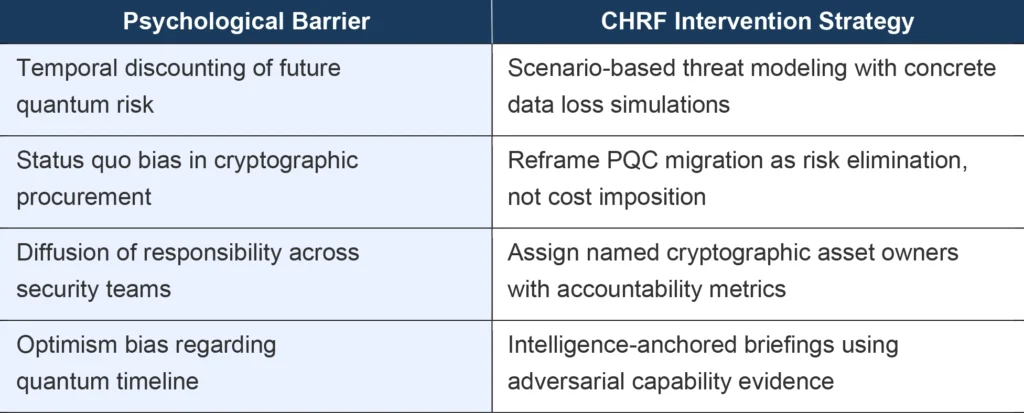
Human cognition is structurally biased toward immediate threats over temporally distant ones, a phenomenon psychologists term temporal discounting. Decision-makers assign disproportionately lower weight to risks that will materialize years in the future, regardless of their magnitude. The quantum threat, currently framed as a 10-to-15-year-horizon event, predictably triggers this bias: budgeting cycles default to present vulnerabilities, leadership attention concentrates on active incidents, and quantum risk is deferred to future quarters that never arrive. Critically, this bias persists even when the correct course of action, beginning PQC migration now to protect data with long retention periods, is explicitly understood.
Status Quo Bias in Cryptographic Architecture
Status quo bias is the cognitive tendency to prefer existing conditions over change, even when the costs of inaction objectively outweigh the costs of action. In enterprise security architecture, this manifests as institutional resistance to cryptographic migration, not because PQC is technically inferior, but because change introduces operational risk, requires vendor coordination, and demands organizational energy. Security teams already stretched across active threat response find it psychologically easier to maintain known-working cryptographic configurations than to undertake complex migration programs against a threat that has not yet materialized in a directly observable way.
Diffusion of Responsibility Across Organizational Hierarchies
Cryptographic migration is a cross-functional problem that spans security architecture, application development, procurement, legal, and executive leadership. This organizational breadth creates a diffusion-of-responsibility dynamic in which each stakeholder group implicitly assumes that another group owns the migration mandate. Security teams assume executives will drive prioritization; executives assume security teams are managing it operationally; procurement officers assume security teams will specify PQC requirements. The result is a collective action failure in which acknowledged risk produces no accountable owner.
Optimism Bias and Adversarial Capability Underestimation
Optimism bias, the tendency to believe that negative outcomes are less likely to affect oneself than others, systematically skews organizational quantum risk assessments. Security leaders frequently cite pessimistic quantum timelines (“it will be 20 or 30 years”) to justify deferred action, even when intelligence community assessments suggest a shorter horizon. This bias is compounded by adversarial opacity: nation-state quantum programs operate under classification, meaning organizations cannot directly observe the capabilities being developed against their infrastructure.
The Solution: A Behavioral Science-Informed PQC Migration Methodology
Addressing the quantum readiness gap requires a dual-track approach that addresses both the technical and behavioral dimensions simultaneously. The proposed methodology integrates NIST PQC standards with cyberpsychology intervention strategies derived from the CHRF, producing a migration program that accounts for how security decisions are actually made within organizations.
Reframing the Threat: From Future Risk to Present Exposure
The most consequential behavioral intervention is temporal reframing. Organizations must shift internal communication around quantum risk from a future-tense framing (“quantum computers will eventually threaten our encryption”) to a present-tense exposure framing (“our encrypted data is being collected today for future decryption”). This reframing is not rhetorical; it is factually accurate, supported by intelligence reporting and academic research, and it directly counteracts temporal discounting by anchoring the threat in current adversarial behavior rather than projected future capability.
Concretely, this means security leaders should brief organizational decision-makers using harvest-now-decrypt-later threat scenarios anchored to specific data assets the organization holds. A healthcare organization should be presented with a scenario in which its encrypted patient records, transmitted over TLS today, are subsequently decrypted after an adversary acquires quantum capabilities, with regulatory, liability, and patient safety consequences described in concrete terms. This scenario-based briefing approach has demonstrated efficacy in behavioral security research for overcoming temporal discounting in other risk domains.
Applying the CHRF: Mapping Cognitive Barriers to Intervention Strategies
The following framework maps identified psychological barriers to targeted intervention strategies for quantum readiness programs:
Cryptographic Asset Ownership and Accountability Architecture
Addressing diffusion of responsibility requires an explicit organizational structure. Organizations should designate a Quantum Readiness Officer (QRO), a role that can be fulfilled by an existing CISO, Deputy CISO, or senior cryptographic architect, with specific accountability for PQC migration progress. Below this role, cryptographic asset ownership should be assigned at the system and application levels, creating a named accountability chain that eliminates organizational ambiguity and enables collective action.
Accountability should be operationalized through a Cryptographic Risk Register, a living document cataloging each cryptographic dependency, its quantum vulnerability status, its data sensitivity classification, and its assigned migration owner and timeline. Board-level reporting on Cryptographic Risk Register progress transforms PQC migration from a technical backlog item into a governance accountability metric, applying the same organizational pressure that has proven effective in accelerating other compliance-driven security initiatives.
Behavioral Integration into the Technical Migration Pipeline
The four-phase PQC migration roadmap, cryptographic inventory, standards adoption, hybrid protocol deployment, and full PQC transition must incorporate behavioral checkpoints alongside technical milestones. Each phase gate should include an organizational psychology assessment: Are decision-makers engaged? Is accountability assigned? Are temporal reframing communications active? Is vendor PQC progress being monitored and reported? Technical migration pipelines that omit behavioral governance consistently stall at the organizational friction points that the CHRF predicts.
Integration into General Use: From Framework to Enterprise Practice
The behavioral PQC migration methodology described above is not exclusively applicable to large enterprises or federal agencies. It scales across organizational types and sizes through deliberate adaptation.
Small and Mid-Sized Organizations: The QRO function can be fulfilled by the existing CISO or IT security lead without a dedicated hire. The Cryptographic Risk Register can be implemented as a structured spreadsheet before maturing into dedicated tooling. Threat-reframing briefings can be delivered in a condensed format to executive leadership and board members.
Healthcare Sector: HIPAA data retention requirements make the harvest-now-decrypt-later threat particularly acute, as patient records retained for years under current encryption will remain accessible to future quantum adversaries. Behavioral interventions should emphasize regulatory exposure and patient safety narrative to overcome temporal discounting among healthcare executives.
Federal Agencies: The Office of Management and Budget memorandum M-23-02 has already established quantum-readiness reporting requirements for federal agencies. Behavioral methodology integration should align with existing FISMA governance structures by incorporating PQC migration status into risk management framework reporting cycles.
Critical Infrastructure: For operational technology and industrial control system environments, quantum readiness must account for both the behavioral barriers described above and the extended lifecycle constraints of embedded systems. Behavioral interventions should target procurement decision-makers specifically, as cryptographic agility requirements embedded at the procurement stage represent the highest-leverage behavioral intervention available.
Conclusion: Security Leaders Must Address Both the Algorithm and the Mind
The quantum threat to cryptographic infrastructure is simultaneously a technical problem with a defined solution and a behavioral problem with a more complex one. NIST has done its part: the post-quantum cryptographic standards exist, are implementable, and are sufficient to protect against the quantum threat. The remaining obstacle is human, the constellation of cognitive biases, organizational dynamics, and behavioral patterns that cause organizations to systematically under-respond to high-consequence threats that lack immediate observability.
The Cyber-Hypopsychology Risk Framework provides the analytical structure to diagnose these behavioral barriers with precision. The interventions described in this article, temporal reframing, explicit accountability architecture, scenario-based executive briefings, and behavioral governance integration into technical migration pipelines, provide security leaders with practical tools for closing the gap between acknowledged quantum risk and active organizational response.
The call to action is twofold. First, begin the technical work: inventory cryptographic assets, engage vendors on PQC roadmaps, and deploy hybrid cryptographic schemes on high-priority systems. Second, begin the behavioral work: reframe the threat as present rather than future, assign explicit ownership, and brief organizational leadership with scenarios that make the harvest-now-decrypt-later reality viscerally concrete. Organizations that address only the technical dimension will find their migration programs stalling in organizational friction. Those that address both will be postured to complete the transition before the quantum era renders the choice moot.
Quantum-era cybersecurity is not a problem that technical teams can solve alone. It demands the full integration of behavioral science, organizational governance, and cryptographic engineering. The organizations that recognize and act on this reality today are the ones that will retain defensible security postures tomorrow. 
About DOC Technology Systems, LLC
DOC Technology Systems, LLC is a healthcare cybersecurity firm at the intersection of behavioral security science and quantum-resilient infrastructure. The firm applies cyberpsychology frameworks, including the Cyber-Hypopsychology Risk Framework (CHRF), to help healthcare organizations bridge the gap between technical security capability and human decision-making. Services include quantum readiness assessments, cryptographic risk registers, behavioral security program design, and PQC migration planning. Learn more at www.doctechnologysystemsllc.com
Dr. Troy C. Troublefield, DBA, Ph.D.

Leave a Comment