
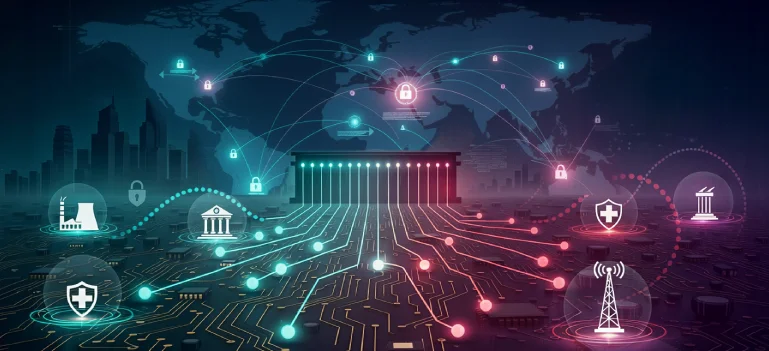
How state-sponsored adversaries are reshaping the threat landscape and what organizations must do to stay ahead
The Problem: A Threat That Has Outpaced Conventional Defense
The cyber threat posed by nation-state actors — and Iranian state-sponsored groups in particular — is no longer a future risk to be planned for. It is an active, daily operational reality for government agencies, critical infrastructure operators, healthcare networks, defense contractors, and financial institutions across the globe. Yet the defensive architecture protecting most of these organizations were designed for a threat landscape that no longer exists.
Iranian APT groups have demonstrated a consistent ability to compromise high-value targets, maintain persistence for months or years without detection, exfiltrate sensitive data, and, when directed, cause physical and operational damage. The 2012 Shamoon wiper attack on Saudi Aramco destroyed the master boot records of roughly 35,000 workstations in a matter of hours. The 2021 attacks on Israeli water infrastructure — attributed to Iranian-linked actors — attempted to alter chemical levels in water treatment facilities. In 2023, the Cyber Av3ngers group, subsequently sanctioned by the U.S. Treasury Department, compromised Unitronics programmable logic controllers at multiple U.S. water utilities. These are not isolated incidents — they represent a deliberate, long-term campaign of pressure and disruption across multiple sectors.
"Nation-state APT actors have moved from opportunistic exploitation to deliberate, long-horizon campaigns — the intrusion you detect today may have begun eighteen months ago."
The problem is compounded by the convergence of three trends: the increasing accessibility of sophisticated offensive tooling (through leaked nation-state implants and the commercialization of exploit frameworks), the blurring of lines between state actors and criminal proxies, and the rapid expansion of the attack surface driven by cloud migration and operational technology (OT) connectivity. Conventional perimeter-focused security architectures are structurally incapable of addressing this threat model.
Root Causes: Why Nation-State APT Operations Persist and Succeed
Structural Permissiveness in Cyberspace
The foundational root cause enabling sustained APT operations is the absence of meaningful deterrence in cyberspace. Attribution, while improving, remains time-consuming and contested. Sanctions and indictments — the primary tools of state-level response — have demonstrated limited effect on the operational tempo of groups operating from within adversarial jurisdictions. Iranian APT actors, like their Russian and Chinese counterparts, operate with near-total legal impunity at home, and the cost-benefit calculus of offensive cyber operations remains decisively favorable for the attacker.
Defender Asymmetry
Attackers need to find one exploitable gap; defenders must protect every surface, continuously. Iranian APT groups excel at patience: the average dwell time for sophisticated intrusions continues to exceed two weeks in many sectors, providing ample opportunity for lateral movement and data staging. Groups such as MuddyWater (tracked by CISA as a subordinate element of Iran’s Ministry of Intelligence and Security) have demonstrated a preference for living-off-the-land techniques — abusing legitimate tools such as PowerShell, WMI, and remote management software — making behavioral detection difficult without mature telemetry.
Talent and Tooling Proliferation
The 2017 Shadow Brokers leak of NSA tools, the subsequent commoditization of frameworks like Cobalt Strike and Brute Ratel, and the global availability of exploit-as-a-service markets have substantially lowered the technical bar for sophisticated intrusion operations. Iranian groups have historically augmented their indigenous capabilities with commercially available offensive tools, enabling faster operational tempos and more deniable attribution. Additionally, Iran has cultivated a domestic cyber workforce through academic institutions and hacking competitions, creating a talent pipeline that sustains long-term investment in APT operations.
Critical Infrastructure as a Strategic Target
Iranian doctrine, reflected consistently in observed TTPs, treats critical infrastructure — energy, water, transportation, healthcare — as a legitimate target for coercive signaling during periods of geopolitical tension. The OT/ICS environments operating this infrastructure were designed for availability and reliability, not security, and frequently run legacy systems with limited visibility. The convergence of IT and OT networks, driven by efficiency demands and digital transformation, has introduced IT-native vulnerabilities into environments where a successful attack can have physical, life-safety consequences.
The Solution: An Intelligence-Led, Defense-in-Depth Framework
Addressing the nation-state APT threat requires a structural shift away from reactive, compliance-driven security postures toward an active, intelligence-informed defense model. No single product or control closes the gap. The solution is an integrated framework built on four interlocking pillars: threat intelligence operationalization, zero trust architecture, OT/ICS-specific security, and cross-sector information sharing. Each pillar must be implemented with sufficient technical rigor to be effective against a sophisticated, adaptive adversary.
Technical Description: Implementing the Framework
Pillar One — Operationalized Threat Intelligence
Strategic threat intelligence — vendor reports, government advisories, CISA alerts — is necessary but insufficient. Effective defense against Iranian APT groups requires operationalized intelligence: indicators of compromise (IOCs), YARA rules, Sigma detection rules, and adversary TTP mappings structured against the MITRE ATT&CK framework that are ingested directly into SIEM and EDR platforms and acted upon within hours, not weeks.
Organizations should maintain a dedicated Threat Intelligence Platform (TIP) — open-source options such as OpenCTI or MISP, or commercial platforms such as Recorded Future or ThreatConnect — and establish a structured process for converting finished intelligence into actionable detections. For Iranian APT groups specifically, CISA, USCYBERCOM, and the Five Eyes intelligence community publish regular joint advisories that include detection-ready artifacts. These should be treated as operational inputs, not reading material.
Key technical controls for this pillar include:
- Automated IOC ingestion from ISAC feeds, CISA KEV catalog, and government advisories into SIEM/SOAR pipelines
- MITRE ATT&CK-aligned detection coverage gap analysis, updated quarterly against observed Iranian APT TTPs
- Threat hunting programs that actively search for precursor behaviors (e.g., T1566 Phishing, T1078 Valid Accounts, T1190 Exploit Public-Facing Application) rather than waiting for alerting
- Deception technology (honeytokens, honeypots aligned with high-value asset profiles) to detect lateral movement early
Pillar Two — Zero Trust Architecture
Iranian APT actors consistently exploit over-permissioned identities and implicit trust between network segments. The Zero Trust Architecture (ZTA) model — mandated for federal agencies under Executive Order 14028 and OMB M-22-09 — eliminates implicit trust and requires continuous verification of identity, device health, and authorization context for every access request, regardless of network location.
Implementation should be sequenced according to the CISA Zero Trust Maturity Model, beginning with identity (MFA enforcement, privileged access workstations, just-in-time/just-enough-access provisioning) before progressing to device, network, application, and data pillars. For environments defending against Iranian APT-level threats, specific attention should be paid to:
- Phishing-resistant MFA (FIDO2/WebAuthn) across all remote access and administrative interfaces — Iranian groups routinely bypass SMS and TOTP-based MFA through real-time phishing proxies
- Conditional access policies that evaluate device compliance posture, user risk score, and location context before granting access to sensitive resources
- Microsegmentation of IT and OT network segments, eliminating flat network architectures that enable unconstrained lateral movement
- Privileged Identity Management (PIM) with just-in-time elevation and session recording for all administrative accounts
Pillar Three — OT/ICS Security
Given Iranian doctrine’s explicit targeting of critical infrastructure OT environments, organizations operating industrial control systems must treat OT security as a distinct discipline, not an extension of IT security. The ISA/IEC 62443 standard and NIST SP 800-82 Guide to ICS Security provide the foundational frameworks, but implementation requires OT-native tooling and expertise.
Critical controls include:
- Passive asset discovery and network traffic analysis using OT-native tools (Claroty, Dragos, Nozomi Networks) that can identify assets and anomalies without disrupting process control communications
- Network segmentation enforced through a Purdue Model-inspired architecture with a secured DMZ between IT and OT zones, and unidirectional security gateways (data diodes) for data flows that require monitoring without bidirectional access
- Firmware integrity monitoring for PLCs, RTUs, and HMIs, with authenticated update processes and hardware-based attestation where supported
- Tabletop exercises and OT-specific incident response plans that account for process safety implications of a cyber event — distinct from IT IR playbooks
Pillar Four — Structured Information Sharing
Nation-state actors benefit from centralized intelligence and shared tooling across their operations. Defenders must counter this through structured, automated, and legally protected information sharing. The Traffic Light Protocol (TLP) framework enables graded sharing, while sector-specific ISACs (E-ISAC for energy, WaterISAC, FS-ISAC for financial services) provide vetted, operationally relevant intelligence.
The CISA Automated Indicator Sharing (AIS) program and STIX/TAXII standards enable machine-speed exchange of threat indicators between organizations and government partners. Participation in AIS should be treated as a baseline expectation, not an optional enhancement, for organizations in critical infrastructure sectors.
The Future: Where Nation-State APT Threats Are Heading
The threat trajectory over the next three to five years is characterized by increasing operational sophistication, broader target scope, and the weaponization of emerging technologies. Several trends warrant specific attention from security planners.
AI-Augmented Offensive Operations
Large language models and generative AI tools are already being leveraged by Iranian and other nation-state actors to accelerate spear-phishing content creation, automate vulnerability research, and generate malware variants at scale. Microsoft and OpenAI jointly disclosed in 2024 that Charming Kitten (APT35) had used LLM-based tools for research and social engineering content development. As AI capabilities mature, defenders should anticipate AI-assisted fuzzing of industrial control system protocols, automated generation of polymorphic malware evading signature detection, and deepfake-enabled social engineering targeting privileged users.
Supply Chain and Trusted Third-Party Exploitation
The SolarWinds intrusion demonstrated the catastrophic potential of supply chain compromise as an initial access vector. Iranian APT groups have adopted this playbook, targeting managed service providers, software vendors, and trusted technology partners to achieve broad, deniable access to downstream targets. Organizations must extend their threat model beyond their own perimeter to encompass the full software and services supply chain.
Cyber-Physical Convergence
As the Internet of Things (IoT) and Industrial IoT (IIoT) expand the connectivity of physical systems, the attack surface for cyber-physical attacks grows correspondingly. Iranian doctrine has demonstrated a clear willingness to cross the threshold from cyber to physical effect — a trend that will intensify as more critical systems become network-addressable. Future intrusions against water, energy, and transportation infrastructure should be planned for with the assumption of physical consequence.
Integration Into General Practice
The framework described above is not a theoretical construct — it maps directly to existing guidance from CISA, NIST, the NSA Cybersecurity Directorate, and the Five Eyes intelligence community. Integration into general practice requires organizational commitment at the executive level, dedicated resourcing, and a programmatic rather than project-based approach to security maturity.
Organizations should begin with a MITRE ATT&CK-based assessment of their current detection coverage against Iranian APT TTPs, using the ATT&CK Navigator tool to identify and prioritize gaps. This assessment should drive a twelve-to-eighteen-month roadmap with measurable milestones aligned to the four pillars. Sector-specific ISAC membership, CISA’s free Cyber Hygiene Services (including vulnerability scanning and web application assessment), and the CISA Cybersecurity Advisory catalog are all no-cost resources that should be fully utilized before additional commercial investment.
For smaller organizations with limited security staff, managed detection and response (MDR) providers with demonstrated experience in nation-state threat hunting offer a viable path to operationalizing intelligence-led defense without building an in-house SOC from scratch. Regardless of organizational size, tabletop exercises simulating Iranian APT intrusion scenarios — including both IT and OT phases — should be conducted at minimum annually.
Conclusion: A Call to Action
The Iranian and broader nation-state APT threat is not a problem that will be solved by a single technology purchase, a compliance checkbox, or a one-time assessment. It is a persistent, adaptive, well-resourced adversarial campaign that will continue to evolve in sophistication and scope. The organizations and sectors that will successfully defend against this threat are those that treat cybersecurity as an operational discipline — one that demands continuous investment, intelligence integration, skilled practitioners, and executive accountability.
The cost of preparation is measured in budget lines and operational adjustments. The cost of unpreparedness is measured in data breaches, infrastructure failures, and national security consequences.
Security practitioners should act now to assess MITRE ATT&CK coverage gaps against Iranian APT TTPs, enroll in sector ISAC sharing programs, and initiate Zero Trust architecture planning. Executives and board members should demand evidence-based security program metrics tied to the actual threat, not checkbox compliance. Policymakers should accelerate the development of binding minimum cybersecurity standards for critical infrastructure operators and strengthen international frameworks for attribution and consequence.
The adversary is already inside the perimeter of some organization reading this article. The question is not whether nation-state threats are real — it is whether the defensive architecture in place is adequate to detect, contain, and recover from them. The answer, for most organizations today, is no. That is a solvable problem, but only if action is taken with the same urgency the threat demands. 
Douglas Kaluhiokalani

Leave a Comment